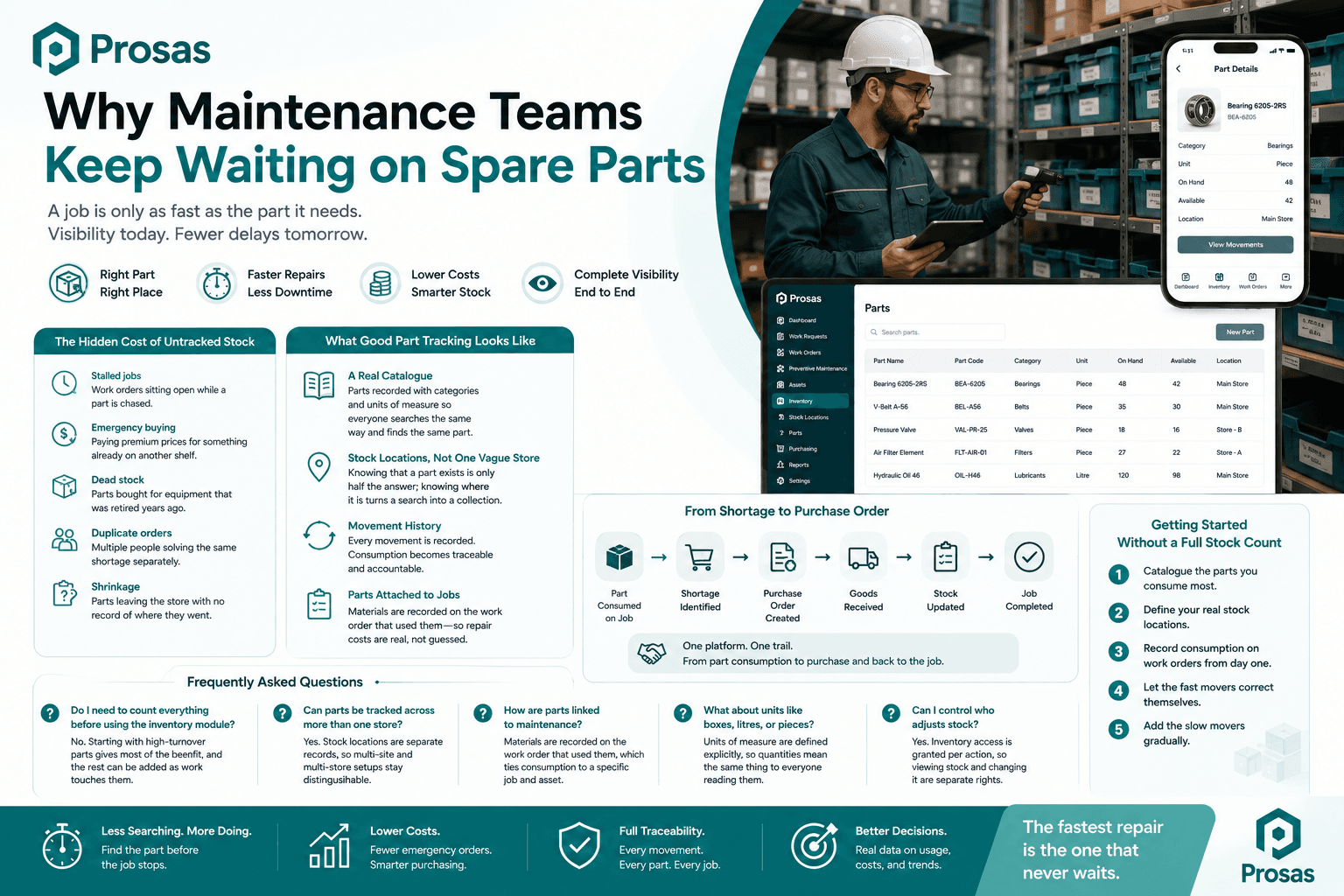
Why Maintenance Teams Keep Waiting on Spare Parts
Ask a technician what slows them down and the answer is rarely the repair. It is the trip to the store that turns out to be empty, the part that exists somewhere but nobody knows which site, or the order that was never placed because everyone assumed someone else had placed it.
Maintenance speed is not only a labor problem. A work order is only as fast as the part it needs.
Prosas keeps parts, stock locations, and work orders in the same system, so the question “do we have it?” has an answer before anyone walks to the store.
The Hidden Cost of Untracked Stock
Teams without part visibility pay for it twice — once in delay and once in waste:
- Stalled jobs — work orders sitting open while a part is chased
- Emergency buying — paying premium prices for something already sitting on a shelf elsewhere
- Dead stock — parts bought for equipment that was retired two years ago
- Duplicate orders — three people solving the same shortage separately
- Shrinkage — parts leaving the store with no record of where they went
Most teams do not have a spare-parts shortage. They have a spare-parts visibility problem.
What Good Part Tracking Looks Like
A Real Catalogue
Spare parts are recorded as their own items with categories and units of measure — so a box, a metre, and a piece are never confused, and two people searching for the same component find the same record.
Stock Locations, Not One Vague Store
Stock lives in defined locations. Knowing that a part exists is only half the answer; knowing where it is turns a search into a collection.
Movement History
Every movement leaves a record, and every part record keeps who created and last updated it. Consumption becomes traceable instead of a quarterly surprise during a stock count.
Parts Attached to Jobs
Materials are recorded on the work order that consumed them. This is what connects a repair to its true cost — and what makes it possible to see which asset quietly eats the parts budget.
From Shortage to Purchase Order
Knowing you are short is only useful if the next step is easy. Because purchasing, inventory, and maintenance sit on the same platform in Prosas, the path from a consumed part to a purchase order to a received delivery stays in one trail rather than jumping from a spreadsheet to an email to a paper note.
The same connection works in reverse. When invoicing looks at what a job cost, the parts are already attached to it.
Getting Started Without a Full Stock Count
A complete inventory audit is the reason many teams never begin. It is not required to start:
- Catalogue the parts you consume most — the fast movers, not the long tail.
- Define your real stock locations as they physically exist.
- Record consumption on work orders from day one, even before the counts are perfect.
- Let the fast movers correct themselves — a few weeks of real movement data is more accurate than one heroic count.
- Add the slow movers gradually, as jobs touch them.
Frequently Asked Questions
Do I need to count everything before using the inventory module?
No. Starting with high-turnover parts gives most of the benefit, and the rest can be added as work touches them.
Can parts be tracked across more than one store?
Yes. Stock locations are separate records, so multi-site and multi-store setups stay distinguishable.
How are parts linked to maintenance?
Materials are recorded on the work order that used them, which ties consumption to a specific job and asset.
What about units like boxes, litres, or pieces?
Units of measure are defined explicitly, so quantities mean the same thing to everyone reading them.
Can I control who adjusts stock?
Yes. Inventory access is granted per action, so viewing stock and changing it are separate rights.
The Fastest Repair Is the One That Never Waits
Technicians are rarely the bottleneck. Parts are. A team that knows what it has, where it sits, and what it consumed last month spends its time repairing instead of searching.
With Prosas, spare parts, stock locations, purchasing, and work orders share one record — so the part is found before the job stops.