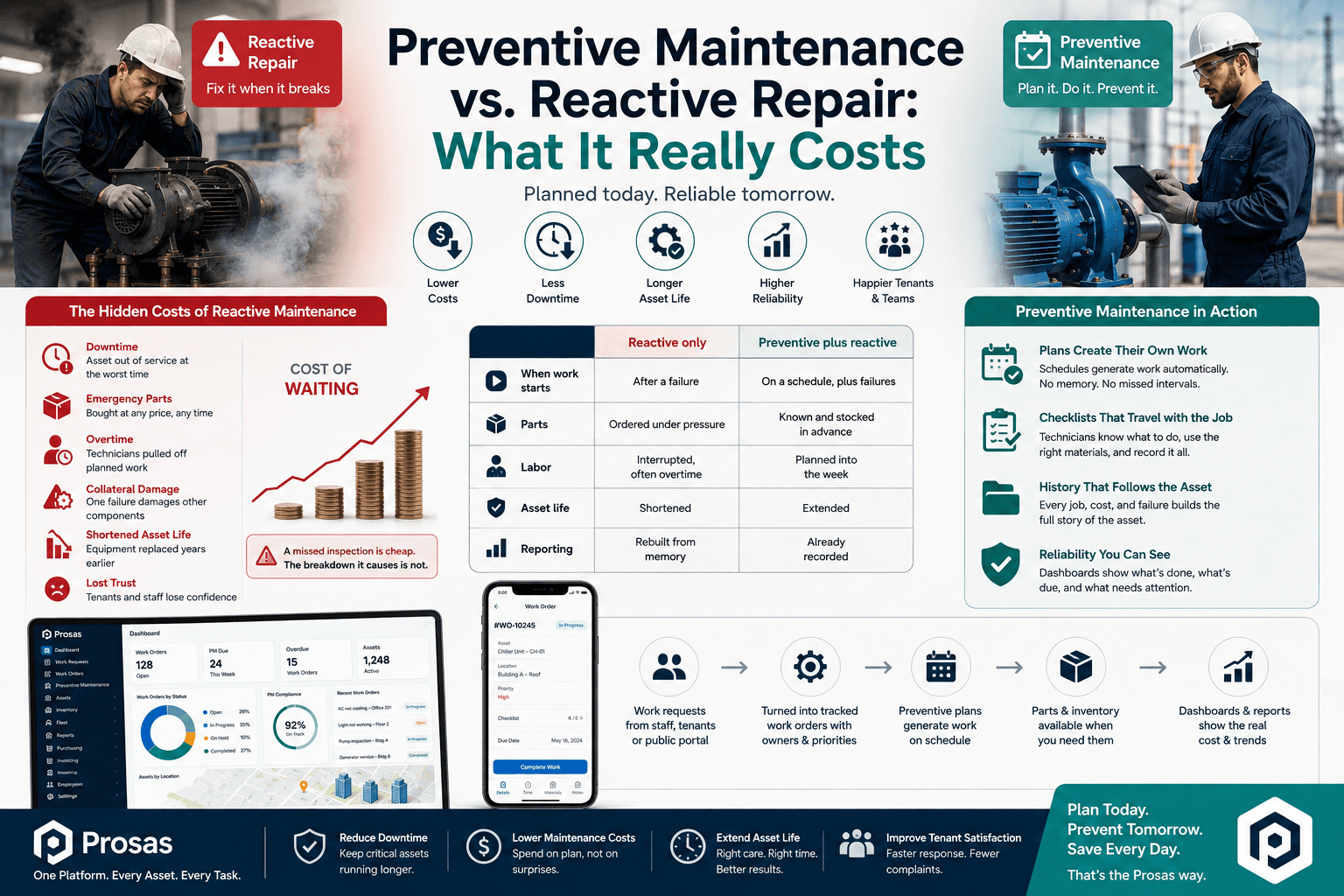
Preventive Maintenance vs. Reactive Repair: What It Really Costs
Every maintenance team works somewhere on a line between two habits. At one end, work happens because something broke. At the other, work happens because a plan said it was due. Most teams sit closer to the first end than they would like to admit.
Reactive repair feels cheaper, because nothing is spent until something fails. The cost only shows up later — in overtime, in emergency part orders, in equipment that ages faster than it should, and in the hours a manager spends explaining a breakdown nobody saw coming.
This is where Prosas shifts the balance. Maintenance plans, asset history, and work orders live in one place, so planned work stops depending on whoever happens to remember it.
The Real Cost of Waiting for Something to Break
An unplanned failure is never a single line item. It arrives with a group of costs attached:
- Downtime — the asset is out of service at the least convenient moment
- Emergency purchasing — parts bought at whatever price is available today
- Overtime — technicians pulled off planned work to fight a fire
- Collateral damage — one failed component quietly damaging others
- Shortened asset life — equipment replaced years earlier than budgeted
- Lost trust — tenants and staff who stop believing the report will be fixed
None of these appear on the repair invoice, which is exactly why reactive maintenance keeps looking affordable on paper.
A missed inspection is cheap. The breakdown it causes is not.
What Preventive Maintenance Actually Looks Like
Plans That Create Their Own Work
A preventive plan in Prosas is attached to real assets and a real schedule. When the interval comes around, the work is generated for you — it does not wait for someone to remember, and it does not disappear when that person is on leave.
Checklists That Travel with the Job
Each work order can carry its own checklist, materials, and labor hours. The technician sees exactly what this inspection covers, and the record of what was actually checked stays attached to the job instead of living on a paper card in a van.
A History That Follows the Asset
Every job is linked to the equipment it touched and to the exact place it sits — facility, building, floor, room. Over time each asset builds its own file: what failed, how often, what it cost, who worked on it. When the repair-or-replace conversation arrives, the answer is already in the data.
Reactive Work Will Never Disappear — and That Is Fine
No amount of planning removes emergencies. A pump still fails on a Friday. The goal is not zero reactive work; it is making sure reactive work is the exception you can absorb rather than the routine that consumes the week.
Prosas handles both in the same system. Anyone can raise a work request with photos; it becomes a tracked work order with an owner, a priority, and a status. Jobs that go past their due date can be escalated instead of quietly ageing at the bottom of a list.
| Reactive only | Preventive plus reactive | |
|---|---|---|
| When work starts | After a failure | On a schedule, plus failures |
| Parts | Ordered under pressure | Known and stocked in advance |
| Labor | Interrupted, often overtime | Planned into the week |
| Asset life | Shortened | Extended |
| Reporting | Rebuilt from memory | Already recorded |
How to Start Without Overwhelming the Team
Teams that try to schedule everything on day one usually abandon the effort by month two. A narrower start works better:
- Register the assets that hurt most when they stop — not the whole estate, just the critical ones.
- Write down what already gets done informally — most teams have unwritten routines worth capturing.
- Put those routines on a plan and let the system generate the work.
- Route every ad-hoc report through work requests, so reactive work becomes visible too.
- Review after one quarter — the asset history will show which intervals were too tight and which were too loose.
Frequently Asked Questions
Is preventive maintenance worth it for a small portfolio?
Usually yes, because small teams have the least slack. One unplanned failure consumes a much larger share of a small team's week than a large one's.
How do I know the right interval?
Start with the manufacturer's recommendation and adjust using your own history. After a few cycles, the record of actual failures tells you more than any generic schedule.
Can Prosas handle both preventive and corrective work?
Yes. Planned maintenance and reactive work requests both become work orders, so they share one queue, one calendar, and one set of reports.
What happens to a job nobody picks up?
Work orders carry status and priority, and overdue jobs can be escalated rather than sitting untouched.
Do technicians need training to use it?
Most technicians only need the parts of the system that concern them — their assigned jobs, checklists, and materials. Access is granted per module, so nobody is handed screens they do not use.
Planned Work Is Simply Cheaper Work
Reactive maintenance is not a strategy; it is what happens when there is no strategy. The teams that spend the least are rarely the ones that repair the fastest — they are the ones that repair the least often.
With Prosas, planned maintenance, reactive requests, assets, and spare parts sit in one connected record, so the work that prevents failures stops depending on memory.