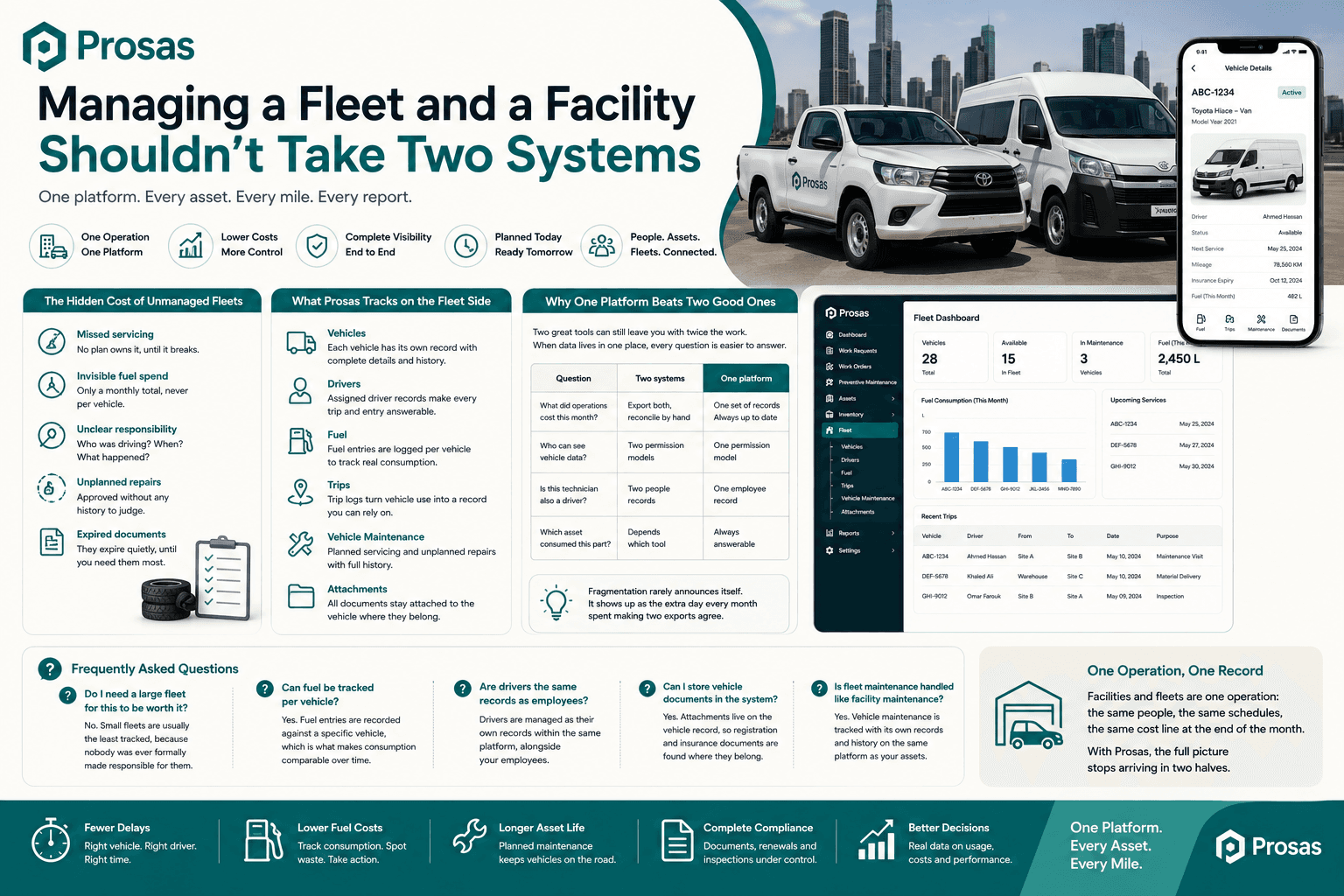
Managing a Fleet and a Facility Shouldn't Take Two Systems
For most operations teams, vehicles arrived quietly. First one pickup for the maintenance crew, then a van, then a few more — and at no point did anyone decide to become a fleet manager. So the fleet ends up managed the way it grew: a spreadsheet of plate numbers, a folder of fuel receipts, and one person who knows when the insurance expires.
Meanwhile the buildings are managed properly, in a real system. The vehicles that keep those buildings running are not.
Prosas treats fleet as part of the same operation, not a separate world.
A Vehicle Is Just Another Asset
Strip away the wheels and a vehicle behaves exactly like every other asset you already manage. It has a service interval. It fails unexpectedly. It consumes parts, labor, and budget. It has a history that determines whether keeping it still makes sense.
The only real difference is that it moves — which makes it easier to lose track of, not less important to track.
- Servicing is missed because no plan owns it
- Fuel spend is visible only as a monthly total, never per vehicle
- Nobody can say who was driving when the damage appeared
- Repairs are approved without any history to judge them against
- Documents expire quietly until the day one is needed
What Prosas Tracks on the Fleet Side
Vehicles
Each vehicle is a record of its own, so its details, documents, and history stop living in someone's memory or inbox.
Drivers
Drivers are assigned records, not names typed into a note. Assignment is what makes every later question — about a trip, a fuel entry, or damage — answerable.
Fuel
Fuel entries are logged per vehicle. A total tells you what you spent; per-vehicle consumption tells you which vehicle changed behaviour this quarter, and that is the number worth acting on.
Trips
Trip logs turn vehicle use into a record instead of an assumption, which matters whenever utilisation, cost allocation, or an incident needs to be reconstructed.
Vehicle Maintenance
Fleet maintenance is tracked like any other maintenance — planned servicing and unplanned repairs, both with a history attached to the vehicle.
Attachments
Registration, insurance, and inspection documents stay attached to the vehicle they belong to, where the next person will actually look for them.
Why One Platform Beats Two Good Ones
A dedicated fleet tool and a dedicated facility tool can both be excellent, and still leave you worse off. Every question that crosses the boundary becomes manual work:
| Question | Two systems | One platform |
|---|---|---|
| What did operations cost this month? | Export both, reconcile by hand | One set of records |
| Who can see vehicle data? | Two permission models | One permission model |
| Is this technician also a driver? | Two people records | One employee record |
| Which asset consumed this part? | Depends which tool | Always answerable |
Fragmentation rarely announces itself. It shows up as the extra day every month spent making two exports agree.
Frequently Asked Questions
Do I need a large fleet for this to be worth it?
No. Small fleets are usually the least tracked, because nobody was ever formally made responsible for them.
Can fuel be tracked per vehicle?
Yes. Fuel entries are recorded against a specific vehicle, which is what makes consumption comparable over time.
Are drivers the same records as employees?
Drivers are managed as their own records within the same platform, alongside your employees, so people are not duplicated across separate tools.
Can I store vehicle documents in the system?
Yes. Attachments live on the vehicle record, so registration and insurance documents are found where they belong.
Is fleet maintenance handled like facility maintenance?
Yes. Vehicle maintenance is tracked with its own records and history, on the same platform as your building and equipment work.
One Operation, One Record
Facilities and fleets are not two departments that happen to share a budget. They are one operation: the same people, the same schedules, the same cost line at the end of the month.
With Prosas, vehicles, drivers, fuel, trips, and vehicle maintenance sit beside your assets, work orders, and spare parts — so the full picture stops arriving in two halves.